If you trade crypto actively, you’ve probably lived this exact moment: gold starts moving, your macro thesis is clear, but execution is slow because your tools are split across too many platforms. One app for crypto, another for traditional markets, another for funding or hedging. By the time everything is connected, the move is already half gone.
That is the real reason “crypto to gold” matters in 2026. It’s not a slogan. It’s a workflow problem.
BYDFi TradFi is interesting because it tries to solve that workflow problem inside a crypto-native environment. Instead of asking traders to rebuild their setup from scratch, it brings selected traditional-finance instruments into the same ecosystem where many users already trade digital assets.
Why the Gold Angle Is the Right Angle
A lot of multi-asset coverage gets too broad too fast. Stocks, indices, forex, commodities, everything at once. But if we’re being practical, gold is still the cleanest bridge asset between crypto and traditional markets.
When risk sentiment shifts quickly, traders often rotate toward defensive exposures. Gold is one of the first places that attention goes. For crypto-native users, being able to move into gold-linked exposure without leaving a USDT-based workflow can be genuinely useful, especially when volatility is high and timing matters.
So yes, this is a multi-asset story, but the core use case is still straightforward: faster access to gold when market tone changes.
What BYDFi TradFi Actually Offers (as of May 2026)
Here’s the grounded version, without overclaiming:
BYDFi announced its TradFi launch in early February 2026, with coverage centered on precious metals and tokenized stocks on web and app. Around the same time, it listed XAUUSDT perpetuals (USDT-margined), which gave users a direct gold-linked instrument inside the platform’s futures framework.
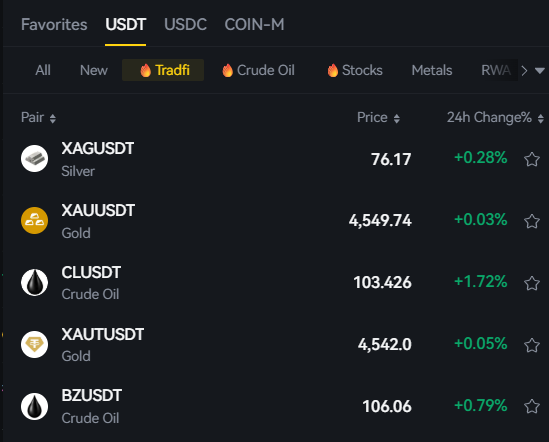
That matters because it keeps execution in one place. If you already operate in a derivatives-first environment, you can monitor crypto positions and gold-linked positions without juggling multiple platforms and account systems.
BYDFi’s public materials also reference broader TradFi expansion over time, and some campaign pages mention forex-related products. But the cleanest confirmed day-one narrative remains precious metals plus tokenized stocks, with gold as the standout anchor.
The Real UX Difference: Less Friction, Faster Decisions
The biggest benefit is not “more features.” It’s fewer interruptions.
When markets are moving, interruption is expensive. Every account switch, every transfer delay, every dashboard jump increases reaction time and decision fatigue. BYDFi TradFi reduces that by keeping your crypto and TradFi-linked execution closer together.
In practical terms, this helps with three things:
- Faster rotation from risk-on to defensive positioning.
- Cleaner portfolio monitoring across crypto and gold-linked exposure.
- More consistent collateral logic when your capital base is already in USDT.
This is why the product resonates more with active traders than with passive investors. It is an execution tool first.
Costs: Helpful Headlines vs Real Trading Economics
Now the honest part.
You may see zero-fee messaging in campaign periods, and those promotions can be useful. But traders should not assume every TradFi trade is permanently “free” under all conditions. BYDFi’s standard fee framework for perpetual trading still exists, and real trading cost is always a combination of multiple factors.
At minimum, watch:
- Maker/taker fees under standard schedule.
- Spread quality during different sessions.
- Funding effects for perpetual-style exposure.
- Slippage when liquidity thins out.
So yes, promotional zero-fee windows are attractive. But your PnL still depends on execution quality and risk control, not headline marketing alone.
Important: Exposure Is Not Ownership
This is where many reviews get vague, and they shouldn’t.
Trading gold-linked contracts or tokenized products on a crypto platform is usually about price exposure, not direct ownership of the underlying physical asset or equity rights. That distinction is fundamental.
If your goal is tactical trading, hedging, or short-to-medium-term positioning, this structure can work well. If your goal is long-term legal ownership rights tied to traditional securities or physical commodity delivery, this is a different proposition.
Neither approach is “better” in absolute terms. They serve different objectives.
Risk Profile: Familiar to Perps Traders, Not Risk-Free
For experienced derivatives users, the mechanics will feel familiar. Position sizing, leverage, liquidation risk, funding behavior, and margin discipline still rule outcomes. Gold may look less chaotic than some altcoins, but leveraged exposure can still move hard enough to punish loose risk management.
In other words, BYDFi TradFi can reduce operational friction, but it does not reduce market reality.
That is not a criticism. It is just how derivatives work, regardless of venue.
Who This Setup Fits Best
BYDFi TradFi is likely a strong fit for:
- Crypto-native traders who want a practical crypto-to-gold workflow.
- Users who already manage positions in a derivatives framework.
- Traders who value speed and cross-market flexibility over asset custody formalities.
It is less ideal for:
- Investors who only want direct underlying ownership.
- Users who are new to leverage and margin risk.
- Anyone expecting “one platform” to replace a disciplined trading process.
Final Take
If the title is “From Crypto to Gold,” the review should stay on that lane. And on that lane, BYDFi TradFi makes sense.
It gives crypto-native traders a faster way to access gold-linked markets in a familiar environment, with USDT-based operational continuity and fewer account-level bottlenecks. That is a meaningful upgrade for active execution.
It is not a magic product, and it should not be framed as one. Costs still need to be modeled properly. Product type still needs to be understood clearly. Risk still needs to be managed every day.
But judged as a practical bridge from crypto workflows to gold exposure, BYDFi TradFi is not just “another feature launch.” It solves a real trading pain point that many users deal with every week.
If you want to evaluate the setup directly, Explore BYDFi TradFi


