Turning Empty Corners Into Quiet Work Spaces
Remote work has made one thing clear: the physical conditions of your work environment affect the quality of the work produced in it. This is not a particularly new insight — office design has been studied seriously for decades — but working from home has made it personal in ways that a shared office never quite did. When the workspace is also your living space, the arrangement of that space is entirely your responsibility.
The overlooked corners of most homes carry more potential than they first appear to. A narrow wall beside a wardrobe, the angle where two walls meet in a bedroom, the underutilized space beside a window — these spots, measured carefully and furnished specifically, can hold a fully functional work setup that takes up less floor space than a dining chair. The alternative — working from a sofa, a dining table shared with meals and household paperwork, or a bed that resists any association with focused attention — makes concentration harder than it needs to be and blurs the boundary between work and rest in ways that affect both.
Minimalist Desk Layouts That Save Floor Space
A floating desk mounted directly to the wall is the most space-efficient work surface available in a small room. With no legs occupying floor space beneath it, the area below remains clear — for a compact chair, for storage, or simply for the visual openness that makes a small room feel larger than its dimensions suggest. The wall bears the weight of the surface and everything placed on it, and the room retains its walkable floor area.
Students study table furniture designed for compact spaces increasingly includes corner configurations that fit the angle where two walls meet — a geometry that freestanding desks cannot efficiently use. A corner desk doubles the usable surface of a straight wall-mounted shelf while keeping the footprint within the angle that would otherwise go entirely unoccupied.
Folding desks that collapse flat against the wall when not in use represent the furthest end of this principle. In a single room that must serve as bedroom, sitting room, and office, the ability to remove the work surface entirely at the end of the day makes the psychological boundary between working and resting considerably easier to maintain.
Tall Bookcases to Clear Your Desk Clutter
A desk surface burdened with notebooks, reference books, stationery, and filed papers becomes harder to work on and harder to leave at the end of the day. The solution is not a larger desk — it is vertical storage positioned within arm’s reach that draws everything off the surface and into a retrievable but contained location.
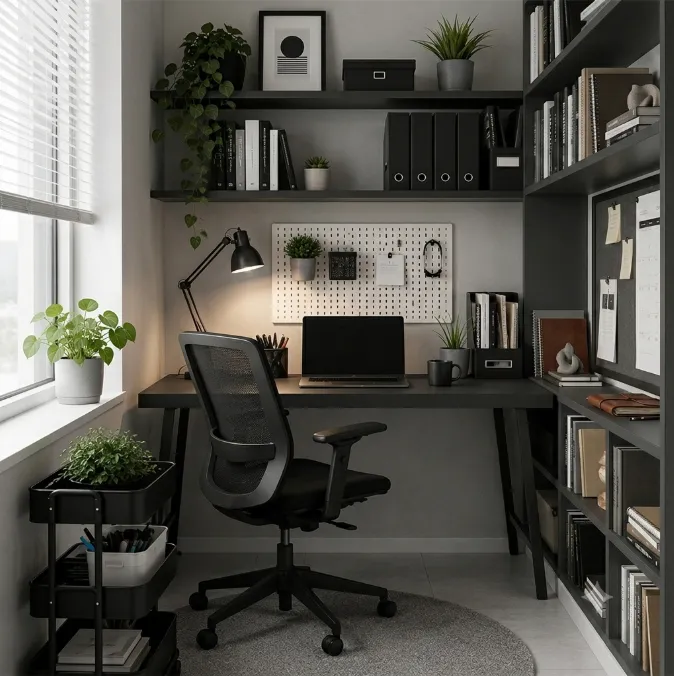
Wooden book shelf designs that run floor to ceiling above a desk make efficient use of the wall area that a floating desk already occupies. The desk handles active work; the shelves above handle everything else — reference materials on one level, notebooks and supplies on another, a row of books read and to-be-read at a height that is visible but not in the way.
Small boxes and bins within open shelving prevent the secondary clutter problem that open shelves can create when items are placed loosely rather than grouped. A box for stationery, a tray for in-progress paperwork, a section for reference books used daily — these divisions keep the visual weight of a loaded bookcase manageable and make individual items easier to locate.
Combining Closets and Desks Into Small Niches
The inside of an unused wardrobe alcove is one of the most underused spaces in an Indian bedroom. The dimensions are frequently sufficient — a standard wardrobe depth of fifty to sixty centimeters provides enough surface area for a laptop, a notebook, and a small external screen — and the enclosure naturally isolates the work area from the surrounding room.
Customizing a bedroom cabinet to include a pull-out laptop tray hidden within the wardrobe body is a particularly useful arrangement in studio apartments and shared rooms. The tray extends when work begins and retracts completely when it ends, leaving no visual trace of the workspace when the wardrobe doors close. From inside the room, the office simply ceases to exist outside working hours.
Low partitions — a bookcase placed perpendicular to a wall, a curtain on a ceiling track, a frosted glass panel — can create a similar effect in open-plan spaces where a wardrobe alcove is not available. The partition does not need to be tall or solid to be effective; it needs only to interrupt the sightline between the bed and the desk enough to create a psychological distinction between the two zones.
Setting Up Your Workstation Near Natural Light
Natural light is the most effective and least expensive improvement available to any home workspace. Positioning a desk to face a window — or to sit perpendicular to one, receiving light from the side — reduces eye strain, supports alertness during working hours, and makes the workspace feel less enclosed than a setup in an interior corner with only artificial lighting.
The orientation matters. A desk facing directly toward a bright window creates glare on screens; a desk positioned with the window to one side avoids this while still receiving the benefits of natural light throughout the morning or afternoon depending on which direction the window faces.
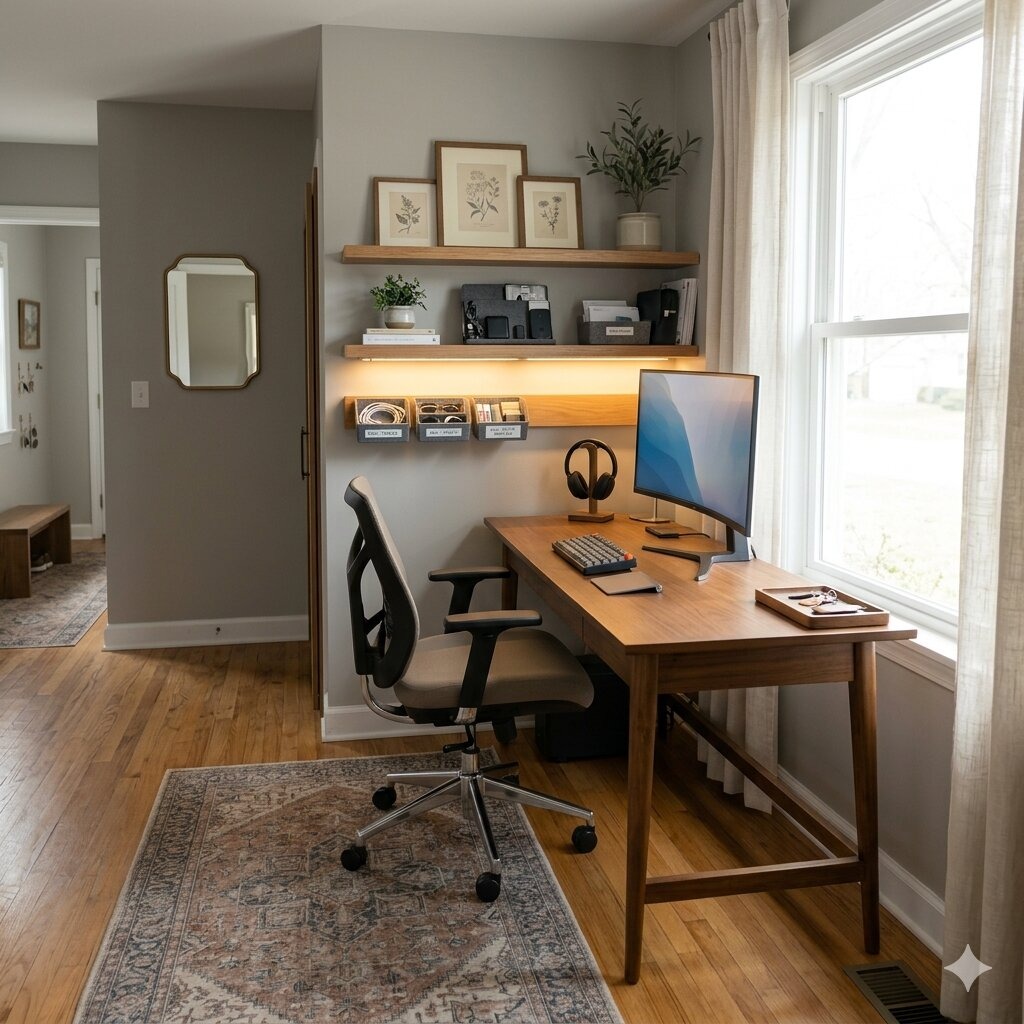
Under-shelf lighting — small LED strips mounted to the underside of shelves above the desk — fills in the shadows that natural light alone leaves during overcast days or evening working hours. Warm-toned strips are easier on the eyes during extended screen work than cool white alternatives and contribute to a work atmosphere that remains comfortable across long sessions.
Tucking the chair completely under the desk surface when stepping away opens the walkway beside the desk — a detail that matters considerably in narrow rooms where the desk sits beside a bed or wardrobe, and where a pushed-back chair can block movement entirely.
Conclusion: Blending Hard Work With Creative Reading Corners
The most effective small home office is not the one with the most equipment or the most carefully sourced furniture. It is the one that is consistently used — and consistent use follows from a setup that is comfortable to be in, easy to return to, and genuinely separate from the rest of the room in function if not in physical location.
Pairing a well-positioned laptop desk with accessible bookshelf storage covers both the active and the passive sides of knowledge work: the surface where things get done, and the resource library that supports the work and the reading that makes it better over time.
A small apartment corner, fitted with the right desk, properly lit, and supported by vertical storage designed to hold rather than scatter, becomes something genuinely useful — a place that has a clear purpose within the home, holds its organization across a working week, and earns its square footage every day it is used.