I’m going to be blunt: when I’m nervous, fumbling, or stuck trying to say something important, the heart races, thoughts tangle, and my mouth doesn’t cooperate. That’s life. But there’s a short, powerful dua in the Qur’an that always calms me down when I remember it — “Rabbi Ishrah Li Sadri Dua.” It’s simple, human, and direct. It’s also the exact prayer Prophet Musa (Moses, peace be upon him) said when he was sent with a terrifying task. It’s in Surah Taha, verses 25–28, and it’s become for many of us the go-to supplication before exams, presentations, meetings, or any moment we need clarity, courage, and clear speech.
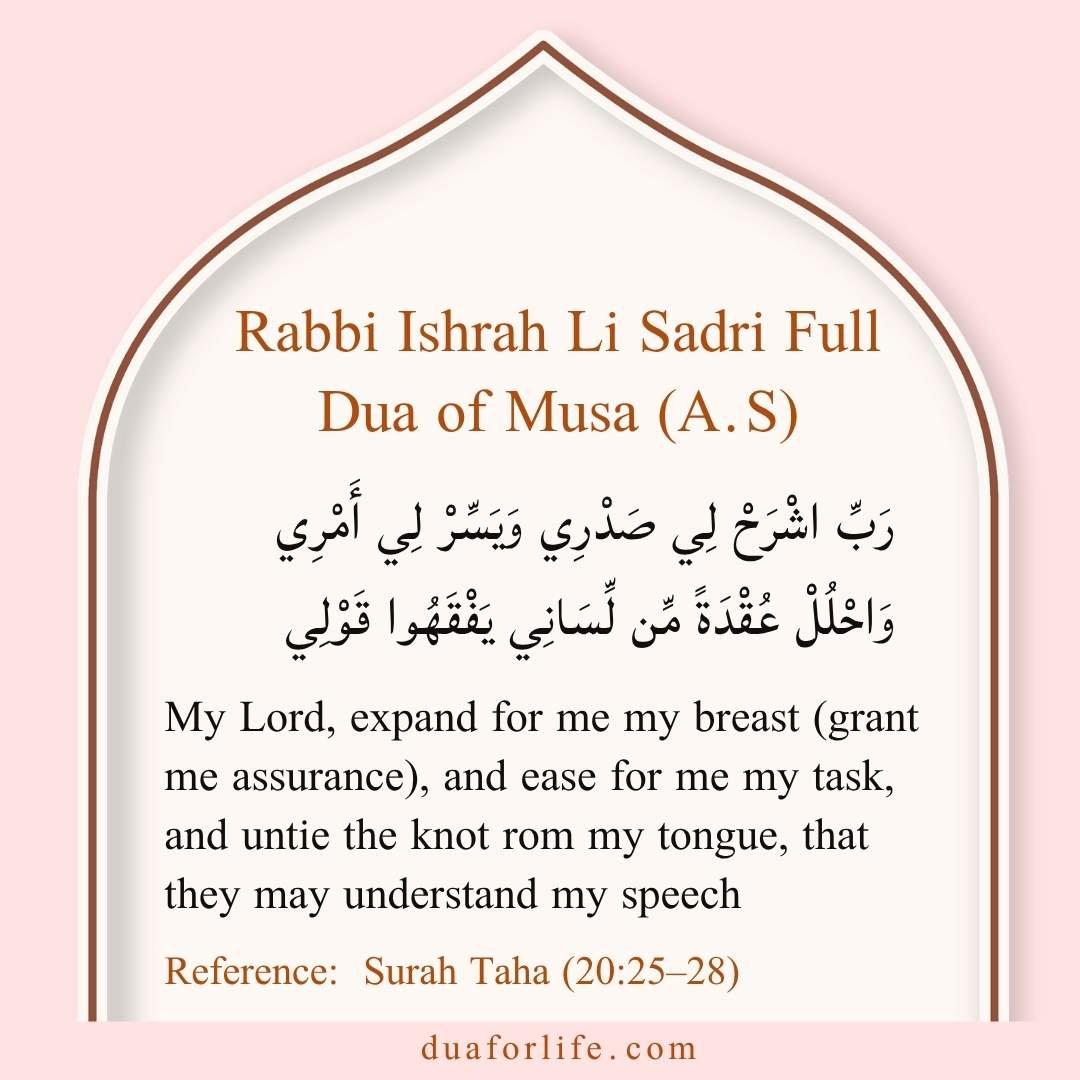
In this post I’ll give you the Arabic with harakat, a faithful transliteration, a clear translation, the original Quran reference, and practical guidance on when and how to recite it. I’ll also share what this dua does — not in some mystical, vague way — but in usable, everyday terms: it steadies the chest, untangles words, and asks Allah to make the path easier. If you want to use it before exams, interviews, da‘wah, or any challenging conversation, this post is for you.
Recommended: Dua for Tahajjud in English, Arabic with Meaning: Best Thajjud Dua
A brief overview of this dua — Rabbi Ishrah Li Sadri
This is one of those short Qur’anic duas that is packed with meaning. It’s not a generic prayer; it’s tied to a moment in Prophet Musa’s life — a moment of daunting responsibility. Allah sends Musa to confront Pharaoh, a tyrant with power and cruelty. Musa asks for inner strength first — “expand my chest” — then for ease in the task, then for help with speech so the listeners understand the message. The dua addresses inner state (calmness, confidence), external circumstances (ease of task), and practical obstacles (speech impediments or nervousness). Quran
Because it’s from the Qur’an, many scholars and teachers recommend it as a model dua whenever we face important, speech-dependent, or stressful tasks — public speaking, exams, difficult conversations, or any moment where we need courage and clarity. You’ll find it commonly taught as an “exam dua,” a “du‘a for public speaking,” or a general dua for calmness and fluency. sahlah.net
Recommended: Rabbana La Tuzigh Qulubana Full Dua in English with Benefits
Benefits of reciting Rabbi Ishrah Li Sadri
I want to be concrete here. When people talk about benefits, sometimes it becomes vague. Below are tangible ways reciting this dua helps — from lived experience and common practice in the Muslim community, plus what classical commentators highlight.
-
Calms anxiety and steadies the heart. “Expand my chest” is a request for inner calmness — emotional breathing room that reduces panic and nervousness.
-
Makes tasks feel more manageable. “Ease for me my task” isn’t magic; it’s asking Allah to remove obstacles and give facilitation — which often comes as better planning, focus, and help at just the right moment.
-
Improves speech and communication. “Untie the knot from my tongue” is directly about speech — fluency, clarity, and removing shyness or stuttering in crucial moments. That’s why students recite it before exams and speakers recite it before presentations.
-
Builds confidence rooted in reliance on Allah. The dua shifts the source of confidence from self to Allah — which, paradoxically, strengthens natural confidence because the weight of “everything depends on me” lifts.
-
Focus and clarity. By asking for an expanded chest and ease in task, you often experience clearer thinking and better recall (useful for tests or impromptu speaking).
-
Spiritual consolation. It ties the immediate emotional state to the Divine, reminding you you’re not alone in the struggle. That matters more than we think when pressure is high.
These benefits are not promises of instant results, but they shape your posture and invite Allah’s help — which then works through practical channels (calm breath, clearer thought, timely assistance). My Islam
Recommended: Dua for Rizq and Success: Duas for Increasing Rizq and Success
 When & How to Recite this Dua
This is the section I come back to the most. The dua is short — so use it often. Here’s how I recommend using it, in everyday, non-ritual ways:
When to recite
-
Before exams or studying sessions. Say it just before you start, and again if you feel stuck. Many students report improved recall and calmer nerves. Before presentations, interviews, or speeches. Just a quiet moment with this dua helps more than frantic rehearsing.
-
Before difficult conversations (family, work, delicate da‘wah). Use it when words matter — to ask for wisdom and clear expression.
-
When making major decisions or starting a challenging task. It’s also appropriate if you need patience and facilitation.
How to recite
-
Make a short wudú (optional) — not required, but it helps you slow down and create a focused mindset.
-
Begin with Bismillah, then say the verses clearly (or the three short lines: “Rabbi ishrah li sadri…”) or silently. Recite with presence.
-
Reflect on the meaning. Don’t just mechanically repeat — think: “I’m asking for calm, ease, and clarity.” That mental connection matters.
-
Follow with personal dua. After the Qur’anic dua, add a short, personal supplication in your own words — ask Allah for specific outcomes or removal of particular obstacles.
-
Breathe before and after. A deep breath in and slow exhale after the dua makes it a micro-practice for calm. This is where spiritual practice meets simple nervous-system regulation.
Recommended: Rabbanaa Faghfir Lanaa Zunoobanaa Dua in English with Benefits
Practical routine example (2 minutes)
-
Take 30 seconds: breathe slowly, say “Bismillah.”
-
Recite the dua (10–20 seconds).
-
Reflect: “Make this meeting easy, help my words be clear.” (20–30 seconds).
-
Deep breath and proceed.
This routine is small and repeatable — exactly what you need in stressful moments.
Recommended: Rabbana Atina Fid Dunya Hasanah Dua: Meaning and Benefits
Personal reflection on Rabbis Rahli Sadri
I don’t tell made-up stories; I keep it short and honest. When I first learned this dua, I used it mostly before exams. At some point it became less about ritual and more about a cue: say the dua, breathe, and remember you’re not carrying the whole thing alone. The effect wasn’t mystical fireworks every time — it was small: my palms less sweaty, my sentences flowing a touch clearer, my mind less frantic. Over time those small changes added up. That’s why I recommend using it as a tiny habit, not a one-off magic trick.
Also: the dua helps me stay humble. Asking for ease and clarity reminds me that knowledge and eloquence are blessings, not only personal achievements. When you internalize that, the anxiety around “performing” loosens.
Recommended: Dua for Success in New Job: Powerful Duas for New Career
Final thoughts
“Rabbi ishrah li sadri” is short but heavy with meaning. It’s a practical spiritual tool for anyone who needs calm, clarity, and clear speech. Use it before exams, talks, or hard conversations — and pair it with practical preparation: study, rehearse, and plan. The dua opens the inward room where calm and competence can grow; what follows — the work, the practice, the Divine facilitation — completes the process. Because it’s from the Qur’an, reciting it carries both spiritual weight and a model of how to ask Allah for help: specifically, humbly, and with clear requests.
For more dua like this, check out this page. You can also check out All Dua page.
FAQs on Rabbi Ishrah Li Sadri
1. What does “Rabbi Ishrah Li Sadri” mean?
It means “My Lord, expand for me my chest” — asking Allah for calmness, confidence, and ease in speech. (Surah Taha 20:25–28)
2. Where is Rabbi Ishrah Li Sadri in the Qur’an?
This dua appears in Surah Taha, verses 25–28, the prayer of Prophet Musa (AS) before speaking to Pharaoh.
3. Who recited Rabbi Ishrah Li Sadri first?
Prophet Musa (AS) recited it when Allah commanded him to deliver His message to Pharaoh.
4. Why do we recite Rabbi Ishrah Li Sadri?
It’s recited to seek Allah’s help for calmness, clarity, and confidence during difficult tasks or public speaking.
5. Can I recite Rabbi Ishrah Li Sadri before exams?
Yes, it’s widely used by students before exams or interviews for focus and inner peace.
6. What are the benefits of Rabbi Ishrah Li Sadri?
It brings peace of mind, eases stress, helps speech flow smoothly, and boosts confidence.
7. How do I pronounce Rabbi Ishrah Li Sadri correctly?
Say: Rabbi ishrah li sadri, wa yassir li amri, wahlul uqdatan min lisani, yafqahu qawli.
8. When should I recite this dua?
Recite it before any important task — exams, meetings, or speeches — or whenever you feel anxious.
9. Can I say this dua in English?
Yes, you can say the meaning in English, but reciting in Arabic holds more spiritual value.
10. Does this dua guarantee success?
No dua guarantees success, but it invites Allah’s help and makes your efforts smoother