I don’t know about you, but I keep coming back to simple, honest pleas. There’s something raw and human about standing before Allah and asking, “Forgive me.” The dua Rabbanaa faghfir lanaa zunoobanaa is one of those short, powerful lines from the Qur’an that does that job — it admits weakness, confesses error, and asks for mercy in a way you can say quietly, anywhere.
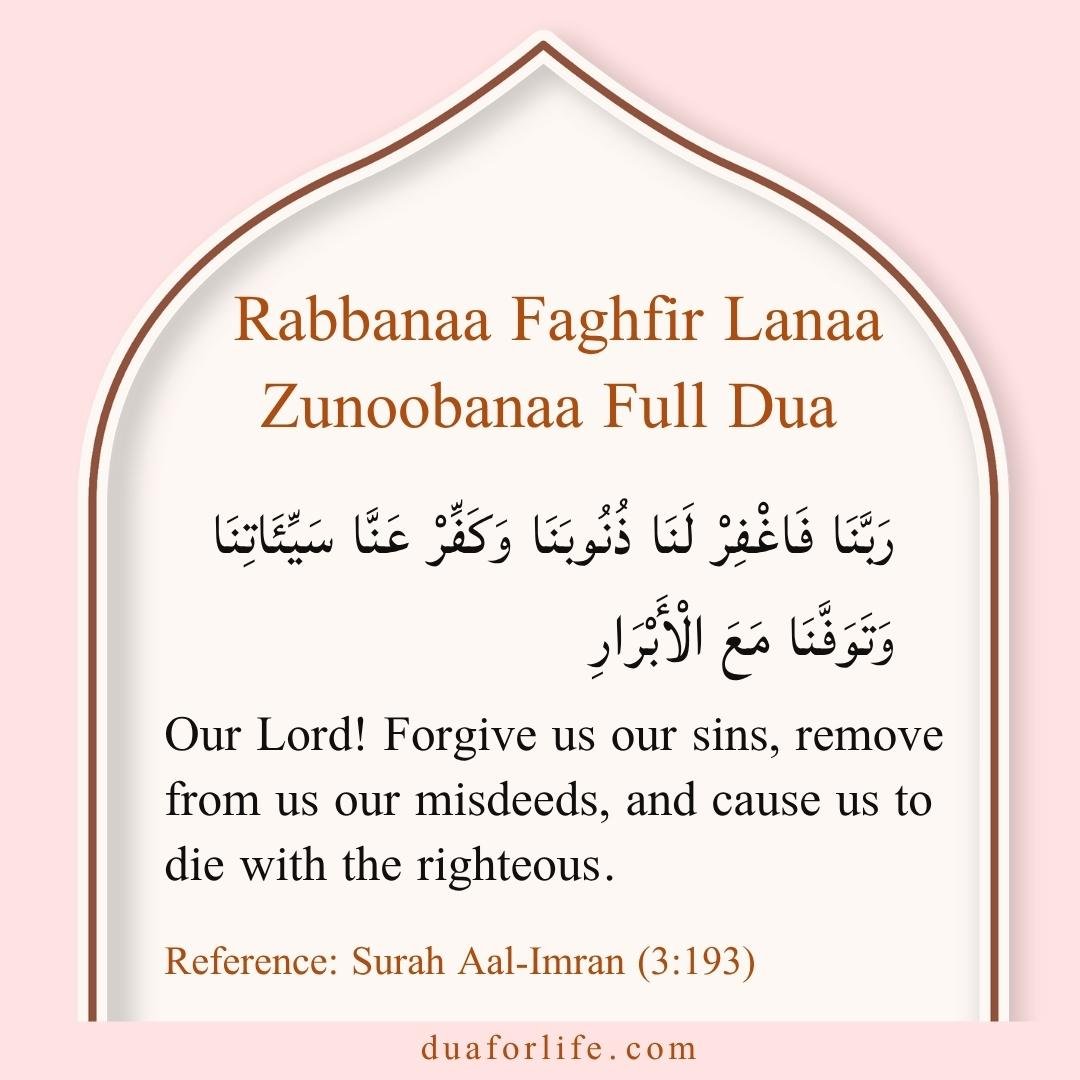
Right from the start I’ll say: this phrase appears in the Qur’an in Surah Āl-ʿImrān — a line the believers made after hearing the call to faith, and it captures both humility and hope. Throughout this post I’ll share the Arabic with harakat, the transliteration, trusted translations, the Qur’anic reference, and practical guidance: when to say it, why it’s meaningful, and how I try to weave it into daily life. I’ll keep things practical and a little personal — the goal is to make this dua feel usable, not just decorative.
Recommended: Benefits of Reciting Sura Kahf Dua: Guidance and Mercy from Allah
Highly Recommended: Quranic Duas PDF: Get the Full List of Duas from the Quran- Free
A brief overview of this dua — Rabbanaa faghfir lanaa zunoobanaa
This dua is spoken by believers in the Qur’an after they respond to the call of the Prophet (a call to faith). It’s both a declaration of belief (“we believed”) and then a request for mercy — “Forgive our sins.” That sequence matters: faith followed by seeking forgiveness. In classical tafsir (exegesis), scholars unpacked the verse to show how acceptance of guidance naturally leads to the recognition of one’s own failings and a plea for Allah’s pardon. The believers are not boasting; they are acknowledging they need mercy.
Historically, this dua is not just a one-off phrase — it’s part of the Qur’anic language that the early Muslim community used and preserved. It’s short, easy to memorise, and spiritually dense: belief, recognition of sin, request for forgiveness, and a hope to be counted among the righteous. That makes it a practical, repeatable dua for daily life.
Recommended: Dua for Happiness and Success: Powerful List of Duas in English
Benefits of reciting Rabbanaa faghfir lanaa zunoobanaa
I like to list benefits because they make spiritual practice feel less abstract. Here are the practical and spiritual benefits people commonly draw from this dua:
Admitting need for Allah’s mercy. Saying “Rabbanaa faghfir lanaa dhunoobanaa” forces honesty: I messed up, I need help. That humility opens the heart.
Connection to the Prophet’s message. The dua is rooted in the believers’ response to the call to faith — it ties your personal plea to the larger story of guidance.
Concise and versatile. Short enough to say on the bus or in the dark before sleep. It’s a quick reset.
Forgiveness focus. It specifically asks for forgiveness — spiritual cleansing that many Hadith and scholars associate with peace of heart and removal of burden.
Fits many contexts. From private reflection to repairing relationships (say it after admitting a mistake), to asking Allah to accept faith — it works.
Comfort in repetition. Repeating this phrase can calm anxiety because it redirects the mind to hope and dependence on Divine mercy.
Backed by Qur’anic authority. It’s not a random phrase; it’s in the Qur’an, giving it special weight and barakah (blessing).
Recommended: Rabbana La Tuzigh Qulubana Full Dua in English with Benefits
Explore this post, Dua for Forgiveness of Zina: 3 Short but Powerful Tawbah Duas
When & how to recite this Dua
There are no rigid rules that limit this dua to a single time — it is flexible. But here are times and ways I personally find it most meaningful:
After Salah (prayer): Right after the formal prayers is a gentle, powerful time to ask forgiveness. Pair it with other dua.
Morning and evening adhkar: Add it to your list of morning/evening remembrances — a short, repeatable ask for the day ahead or the day done.
When you feel guilty: A natural time — when you’ve wronged someone or acted against your better judgment. Saying it refocuses you on repentance (tawbah).
After hearing the call to faith or reminders: If you’re moved by a khutbah, a lecture, or soul-stirring Qur’an, this dua matches the moment — gratitude and immediate seeking of forgiveness.
During sujood (prostration): The closest moment to your Lord — many find prostration an intimate time to say it.
Before sleeping: A small nightly checklist: belief acknowledged, sins asked to be forgiven, sleep with lightness.
Method: Say the words in Arabic if you can, and follow with your heart-language (your own confession) if you need to. Dua is about sincerity. No fancy ritual necessary beyond presence of heart.
Recommended: Rabbi Ishrah Li Sadri Full Dua in Arabic and English: Dua of Musa
Personal reflection on Rabbanaa faghfir lanaa zunoobanaa
I try not to manufacture spiritual stories. What’s true for me is simple: when life gets noisy, the shortest prayers cut through the clutter. I don’t always have the eloquence to compose long supplications. This dua — short, straight — is a stool I can sit on when I’m tired: I ask, I mean it, and I try to change how I act tomorrow. Sometimes I say it in the car after a bad argument, sometimes before a meeting when my heart feels uneasy. It’s a tiny habit, but tiny habits compound. Over time, asking forgiveness changed how I see mistakes: less dread, more course-correcting.
Rabbanaa faghfir lanaa dhunoobanaa is a doorway: short enough to carry, sincere enough to move the heart, Qur’anic enough to anchor practice. If you want one dua to keep close for everyday use — this is a solid, spiritually rich choice. It’s not a magic wand — it’s part of a relationship. Say it, try to live better, and let the asking be the start of the changing.
Recommended: Rabbana Atina Fid Dunya Hasanah Dua: Meaning and Benefits
For more dua like this, check out this page. You can also check out All Dua page.
FAQs Rabbanaa faghfir lanaa zunoobanaa Dua
1. What does “Rabbanaa faghfir lanaa zunoobanaa” mean?
It means “Our Lord, forgive us our sins.” It’s a heartfelt Qur’anic plea for forgiveness.
2. Where is this dua found in the Qur’an?
It appears in Surah Āl-ʿImrān (3:193) as part of a longer supplication by the believers.
3. Is “Rabbanaa faghfir lanaa zunoobanaa” a complete dua?
Yes, it’s complete and powerful on its own, though it’s part of a longer verse in the Qur’an.
4. How often should I recite this dua?
As often as you wish — especially after salah, in the morning, or when seeking forgiveness.
5. Can non-Arabic speakers recite this dua?
Yes, reciting in Arabic is fine even if you don’t know the meaning. Sincerity matters most.
6. What is the context of this dua?
Believers said it after accepting faith, asking Allah for forgiveness and mercy.
7. Is this dua from the Qur’an or Hadith?
It’s from the Qur’an — specifically Surah Āl-ʿImrān (3:193).
8. Does reciting this dua guarantee forgiveness?
It helps seek Allah’s mercy, but true forgiveness comes with sincere repentance.
9. Can children learn this dua?
Yes, it’s short and easy — perfect for teaching kids about seeking forgiveness.
10. How is it different from other forgiveness duas?
It’s directly from the Qur’an and reflects the believers’ humble plea after embracing faith.
Recommended: Dua for Getting What You Want: 6 Most Powerful Islamic Duas