I’ll be honest: some duas feel like umbrellas — small, simple phrases that somehow keep the heart from getting soaked. Rabbana La Tuzigh Qulubana is one of those for me. It’s short, direct, and deeply practical — a plea to Allah to keep my heart steady after guidance, to guard me from drifting when life gets noisy. When I say it, I’m not trying to sound holy; I’m speaking to the One who knows how easily I wobble. I recite it on mornings when I need focus and on nights when I’m uneasy about changes I can’t control.
People search for it in many ways — Rabbana La Tuzigh Qulubana, Rabbana laa tuzigh quloobana, or even “do not let our hearts deviate” — because this dua speaks to a universal truth: guidance is fragile. We may find the right path, but staying firm upon it requires mercy, and mercy only comes from Allah. That’s what makes Rabbana La Tuzigh Qulubana so timeless — it captures the constant need for divine steadiness in a world that pulls us in every direction.
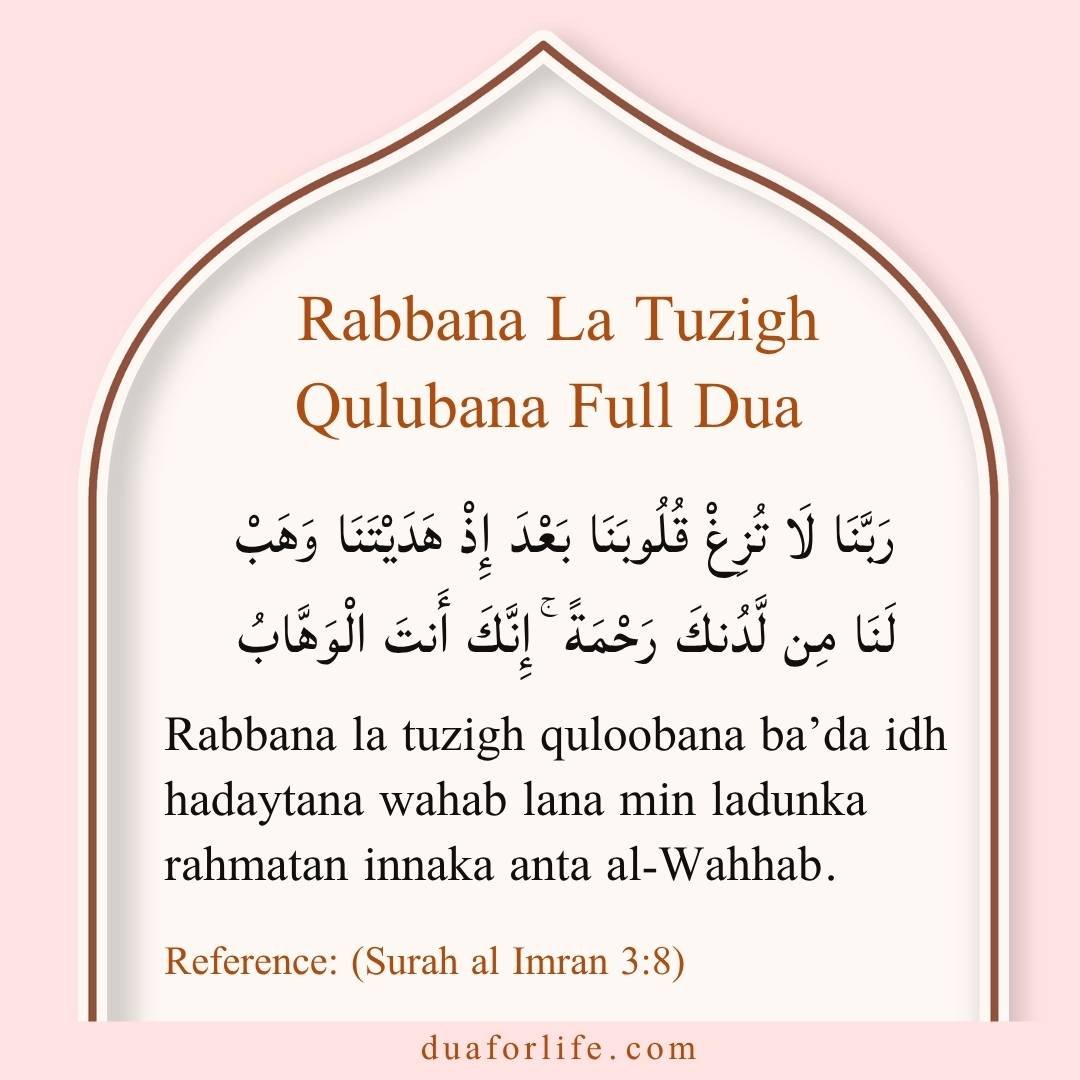
In this post, I’ll share the Arabic with full harakat, a clear transliteration and translation, and the Qur’anic reference (Surah Āl ʿImrān 3:8). I’ll also explain when and how to recite it, its spiritual benefits from both classical meaning and real-life experience, and end with a short personal reflection. If you came here seeking words that steady your heart, you’re in the right place — no complicated theology, just a sincere look at one of the most grounding duas: Rabbana La Tuzigh Qulubana.
Recommended: Dua for Rizq and Success: Duas for Increasing Rizq and Success
Highly Recommended: Quranic Duas PDF: Get the Full List of Duas from the Quran- Free
A brief overview of this dua (Rabbana laa tuzigh quloobanaa)
This dua is embedded in the Qur’an’s narrative of the believers who ask Allah to preserve the guidance granted to them. It’s not a random supplication plucked from a hadith; it is a verse of the Qur’an — which means it carries the weight of direct divine speech and has been preserved within the primary scripture of Islam. The phrase itself focuses on two linked needs: (1) protection from the heart’s deviation after guidance, and (2) a request for mercy — explicitly from Allah Himself. The order matters: first, don’t let our hearts stray; second, give us mercy. The final clause — “innaka anta al-Wahhāb” — reminds us that Allah is the ultimate Giver of gifts, including the gift of a steady heart.
Contextually, the verse sits in a passage where believers are concerned about trials, fitnah (temptation or testing), and the fragility of faith when political or social pressures rise. The dua acts like a safeguard against both internal wavering and external confusion. Because it’s Qur’anic, many scholars encourage memorizing it, reflecting on it, and using it as a regular supplication in both personal dua and communal prayers.
Recommended: Rabbana Atina Fid Dunya Hasanah Dua: Meaning and Benefits
Benefits of Reciting Rabbana La Tuzigh Qulubana Dua
I don’t want to promise miracles, but from both scholarly commentary and lived practice, here’s what people often experience when they make this dua part of their life:
A clearer alignment with guidance. Saying this dua keeps your intention anchored to the guidance you’ve received — you return to your spiritual “North Star.”
Emotional steadiness. The psychological effect of asking for protection helps reduce anxiety about change; it’s a reminder that something Greater is handling the big picture.
Humility before blessing. Recognizing that guidance can be lost cultivates gratitude and humility — both of which strengthen faith.
A natural habit to seek mercy. The dua asks for mercy explicitly, nudging you to rely on divine compassion instead of self-confidence alone.
Quick to memorize and use. Because it’s short and Qur’anic, you can drop it into daily prayers, in between tasks, or during moments of doubt without a long ritual.
I should say — benefits vary. Some people feel immediate comfort, others notice a slow, steady shift in decision-making. The dua is not magic; it’s a practice — and like any practice, its effects compound with sincerity and repetition.
Recommended: Dua for Tahajjud in English, Arabic with Meaning: Best Thajjud Dua
When & How to Recite this Dua
Here’s practical, no-frills guidance:
When to recite
After the five daily prayers (sunnah to make personal duas).
During the quiet moments after Fajr or before sleep — times the heart is naturally reflective.
After learning something that strengthens your faith (e.g., a lecture, a Quran study) — to ask that the guidance stick.
In times of tests, confusion, or when you feel your priorities drifting.
During sujood (prostration) — the place where dua is most intimate.
Recommended: Dua for Getting What You Want: 6 Most Powerful Islamic Duas
How to recite
Pronounce the Arabic clearly; if you can’t, use the transliteration and pair it with the meaning in your language.
Say it with awareness — imagine what “your heart deviating” looks like in real life (smaller prayers, less honesty, cynicism) and ask Allah to protect you from that.
Mix it with other duas: for example, following it with personal requests helps you contextualize mercy and guidance for your life (family, decisions, faith).
Repeat it often, but avoid mindless repetition. A focused 1–3 sincere recitations are worth more than dozens of distracted ones.
Teach it to children and new Muslims; it’s short and foundational.
Recommended: Rabbi Ishrah Li Sadri Full Dua in Arabic and English: Dua of Musa
Personal Reflection on the Dua Rabbana La Tuzigh Qulubana.
I don’t have a dramatic conversion story here — just small moments. I’ve said this dua when a new opinion seemed attractive only because it sounded clever, and also when I felt a slow boredom with things that once humbled me. Each time, the dua nudged me back to basics: prayer, honesty, and a little humility. The most ordinary day-to-day usefulness I’ve found is this: it makes me check my heart. Am I doing something because I truly believe it’s right, or because it’s convenient, fashionable, or protecting my ego? That question, inspired by the dua, is worth more than any immediate comfort.
Recommended: Dua for Success in New Job: Powerful Duas for New Career
Final Thoughts
If you take one thing from this post, let it be this: stability of the heart is a gift, not a given. Guidance can be given — but staying guided is a lifelong task. Rabbana laa tuzigh quloobanaa is a compact, potent expression of that need. It’s Qur’anic, which gives it a special place in worship and reflection. Use it with intention. Say it aloud. Pair it with action. And remember: asking for mercy is not a sign of weakness; it’s the most honest recognition of what we lack and who can fill it.
Recommended: Rabbanaa Faghfir Lanaa Zunoobanaa Dua in English with Benefits
For more dua like this, check out this page. You can also check out All Dua page.