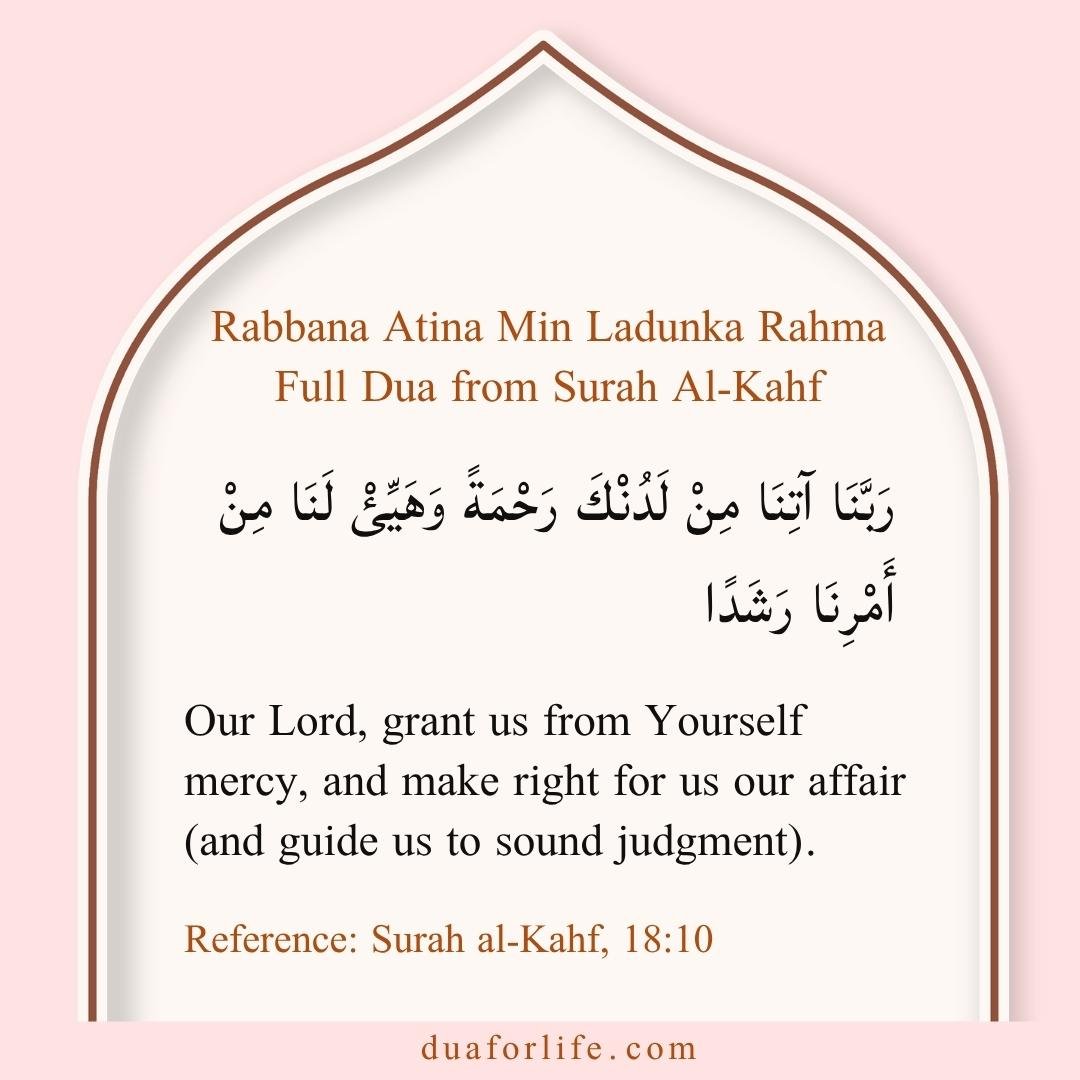
 I’ll be honest: few short lines from the Qur’an settle my heart the way Rabbana Atina Min Ladunka does. It’s one of those duas I whisper when choices feel heavy, when doors close, or when I’m trying to steady myself before a big step. That exact phrase — Rabbana Atina Min Ladunka Rahmatan — is part of a longer supplication the young believers in the story of the People of the Cave said when they fled for their faith. When I read or recite it, I feel like I’m asking for two simple but huge things at once: Allah’s mercy, and practical, straight guidance to help me through whatever mess I’m in.
That combination — mercy and clear guidance — is everything. In this post I’ll give you the Arabic (with harakat), a careful transliteration, a faithful English translation, the Qur’anic reference, why scholars and tafsir connect the words to deep meanings, when and how to use it, practical benefits I’ve noticed, and at the end I’ll answer the questions people are actually typing into Google about this dua. I wrote this as if we’re sitting together — like I’m sharing the dua that calms my chest when life tries to scramble my head. Let’s walk through it slowly, because these words deserve to be understood, felt, and used.
Recommended: Benefits of Reciting Sura Kahf Dua: Guidance and Mercy from Allah
Recommended: Surah Kahf Last 10 Verses: Arabic, English, Benefits & Free PDF
A brief overview of this dua (Rabbana Atina Min Ladunka Rahma)
This dua comes from the beautiful story in Surah al-Kahf about a group of young believers who fled persecution and took shelter in a cave. Facing danger and uncertainty, their immediate response was to turn to Allah — asking not for worldly tricks or instant escape, but for mercy from Allah Himself and for their affairs to be set right (rashad). The request is both humble and precise: “grant us mercy” (which covers protection, forgiveness, and kindness) and “prepare for us rightness in our affair” (which scholars read as asking for guidance, a good outcome, and a wise resolution). The Qur’an records this dua right at the moment of their retreat, showing that when people are in real danger or real doubt, the natural recourse is simple, sincere supplication. (King Saud University Quran Project)
What’s striking is the dua’s balance: it asks for internal mercy (softening the heart, faith, forgiveness) and external guidance (clarity about what to do next). The classical tafsir (explanations by scholars like Ibn Kathir and other commentators) explains rahmah includes both spiritual guidance and Divine protection, while rashad points to being led to a sound, upright outcome — “to be shown the right course.” (King Saud University Quran Project)
Short background & historical context
The youths’ story is not given as a fairy tale; it’s a real spiritual lesson. They left their community to preserve their faith, and they prayed this exact words as they entered the cave. The Qur’an narrates that Allah blessed them with protection and made their sleeping state a sign — an answer that carried mercy and a resolution far beyond their human planning. That outcome (Allah’s mercy and a guiding resolution) is precisely what they asked for in those simple words. If you want to read the full verses and tafsir, many reliable Qur’an resources and classical commentaries cover the passage in detail. (corequran.com)
Recommended: Dua for Happiness and Success: Powerful List of Duas in English
Benefits of reciting (Rabbana Atina Min Ladunka)
I’ll list these conversationally — as things I’ve seen in others and found true in small ways in my own life:
Calm in panic: Saying it pulls my focus from frantic planning to asking the One in charge.
An invitation for mercy: It’s a direct request to Allah’s mercy — not earned by me, but asked for.
Guidance for decisions: The “rashad” part asks for the path to be made sensible and right.
Protection in trials: Historically, the dua was made when the youths needed refuge — it’s a natural dua in times of fear.
Humility reminder: It teaches me to place my limits in front of God and ask Him to act.
Short and memorizable: You can say it in a moment — in sujood, in the car, before the meeting.
Fits many contexts: If you’re starting a job, deciding marriage steps, or facing tests — both inner mercy and outward guidance are appropriate.
I avoid making over-grand claims: it’s not a magic formula, but it’s a Quranic dua — so it’s part of the living guidance the Qur’an offers. When I recite it with sincerity, there’s a practical shift: I make fewer impulsive choices and rest easier.
Recommended: Dua for Rizq and Success: Duas for Increasing Rizq and Success
Recommended: Rabbana Atina Fid Dunya Hasanah Dua: Meaning and Benefits
When and how to recite this Dua
You can recite this dua at any time. That said, here are moments I personally find it most effective:
In sujood (prostration): That’s where I feel closest and most honest.
After obligatory prayers: A short private moment after salah is a great slot.
During real uncertainty: Before a big decision — job, relocation, marriage, or a major purchase.
When you feel overwhelmed or afraid: The original context was fleeing persecution; this dua is natural in fear.
As part of morning or nightly dhikr: Say it with intention, not mechanically.
How to recite:
Read the Arabic as shown above (if you can). If not, read the transliteration or translate it into your own words — the meaning matters.
Mean it. Even a short whisper with attention is better than long repetition without focus.
Combine it with actions: make dua, then take steps. I find that making the dua clarifies the next practical step, and then I take that step with more calm.
Recommended: Dua for Tahajjud in English, Arabic with Meaning: Best Thajjud Dua
My Personal Reflection on the dua (Rabbana Atina Min Ladunka)
I’ll keep this short and real: I don’t recite this dua because it’s popular, or because I think saying it once will magically fix everything in my life. I recite it because whenever my plans start to crumble, I need to remind myself that there’s an Author of outcomes who sees the full picture while I only see fragments. When I turn to Allah with these words, I feel like I’m shifting my focus from “how do I control this mess?” to “how do I trust the One already in control?”
The change is subtle but powerful. Once I ask for mercy and guidance, my mind slows down and stops rehearsing every possible worst-case scenario. Instead of spiraling through endless “what ifs,” I begin to breathe easier. I notice that my sleep becomes more peaceful, my mornings start with less anxiety, and even my decisions feel calmer and clearer. Over time, I realized that this dua doesn’t erase problems — but it reshapes how I approach them.
It’s not mystical magic, and I don’t treat it like a quick fix. What it really does is redirect my energy: from panic toward petition, from self-reliance toward reliance on Allah. And when that shift happens consistently, it shapes the way I act. I make fewer rash calls, I think twice before reacting, and I remind myself that guidance is always a gift I need to ask for. Looking back, this small act of reciting Rabbana Atina Min Ladunka has quietly influenced better decisions and steadier choices in my life.
Recommended: Rabbana Zalamna Anfusana Dua in English, Arabic and Meaning
Final Thoughts — My Last Take
If you carry only one lesson from everything I’ve shared here, let it be this: actually use the dua. Don’t get stuck overthinking the details or waiting for the “perfect” moment. Keep it simple. Say it in Arabic if you can, or say the transliteration if that feels easier, but most importantly, hold onto the meaning in your heart and let it be sincere.
What I’ve come to realize is that mercy and guidance aren’t distant, untouchable ideals — they’re everyday needs. They’re the very things we should be asking for when life feels overwhelming and even when life feels smooth. The beauty of this dua is in its balance: it’s short enough to fit into any small pocket of time, but deep enough to reach into every part of your life. You can whisper it before sleep, breathe it out during stress, or lift it up during prayer, and it still carries weight.
So my last take is simple: don’t just read about it, make it a part of your own rhythm. Make it the phrase that steadies you, the prayer that sits on your tongue when your mind runs restless, and the reminder that there is always Someone greater guiding the outcome. At the end of the day, this dua doesn’t belong only to the story of the youths in the cave — it belongs to anyone who chooses to carry it. So make it yours.
For more dua like this, check out this page. You can also check out All Dua page.
FAQs about Rabbana Atina Min Ladunka Rahmatan Dua
1. Where is the dua Rabbana Atina Min Ladunka in the Qur’an?
It’s in Surah Al-Kahf, verse 18:10, recited by the youths in the cave.
2. What does Rabbana Atina Min Ladunka Rahmatan mean?
It means: “Our Lord, grant us mercy from Yourself.” It’s a plea for Allah’s compassion and protection.
3. What does Rashad mean in this dua?
Rashad means right guidance, a wise outcome, and clarity in one’s affairs.
4. When should I recite this dua?
You can recite it anytime, but especially during fear, stress, or before major decisions.
5. Can I recite this dua without knowing Arabic?
Yes, you can use the transliteration or even pray in your own language — sincerity matters most.
6. How many times should I say Rabbana Atina Min Ladunka?
There’s no fixed number. Say it as often as you need, focusing on meaning, not counting.
7. Is this dua only for the People of the Cave?
No, it’s universal. The Qur’an records it as a timeless model for all believers.
8. Does this dua always change outcomes?
Not always. It asks for mercy and guidance, but Allah answers in the way that’s best for us.
9. How can I use this dua in daily life?
Say it in sujood, after salah, or quietly when you need comfort and direction.
10. Can children memorize Rabbana Atina Min Ladunka easily?
Yes, it’s short, simple, and perfect for kids to learn early.