 If you’ve ever felt torn between comfort, honesty, and something deeper — this dua captures it all in one line. “Rabbana Atina Fid Dunya Hasanah” is a simple request: give me good in this world, good in the next, and protect me from the Fire. That balance — asking for both dunya and akhirah — makes it a timeless guide for a life that’s practical and spiritual.
To me, it’s a reminder that “good” isn’t just wealth or status; it’s health, dignity, meaningful work, and a heart that leans toward mercy. The Hereafter part keeps me honest — success today means nothing if it leaves me empty tomorrow. That’s why this dua feels like a steady anchor, pulling me back to balance whenever I drift.
In this post, I’ll cover everything: Arabic text, transliteration, translation, Qur’an and hadith sources, tafsir insights, how and when to recite, benefits, and a FAQ section with real answers people search for.
Recommended: Rabbana Zalamna Anfusana Dua in English, Arabic and Meaning
A brief overview of this dua (Rabbana Atina Fid Dunya Hasanah)
This is one of those duas that’s short, flexible, and theological in one breath. It appears explicitly in the Qur’an (2:201) where a group of people are described making this supplication; the wording is simple but deep. Because the Prophet ﷺ himself frequently used it (as narrated by the companions), the dua has a double weight: it’s both Qur’anic text and living Sunnah practice. That combination is why many scholars and ordinary people alike treat it as a “go-to” supplication for daily life: it covers worldly needs, spiritual outcomes, and ultimate salvation in one sweep. Tafsir notes also point out that “hasanah” (good) here is intentionally broad — it can include lawful provision, wellbeing, good character, righteous family, and sound end — and scholars often advise making the dua with concrete things in mind (e.g., provision, health, or good deeds) if you want to be specific.
Recommended: Benefits of Reciting Sura Kahf Dua: Guidance and Mercy from Allah
Why the wording matters — “hasanah” and balance
One word — ḥasanah — holds the key. It’s not just “nice” or “more”; ḥasanah implies what’s good, wholesome, beneficial, and proper. So when you ask for ḥasanah in this world, you’re asking for lawful sustenance, safety, meaningful work, mental and physical health, and relationships that don’t corrupt. When you ask for ḥasanah in the Hereafter, you’re asking for a good ending: mercy, closeness to Allah, and a place that’s safe from harm. Coupled with “save us from the punishment of the Fire,” the dua balances desire and fear — desire for the good, and fear that keeps you humble.
Recommended: Dua for Happiness and Success: Powerful List of Duas in English
Benefits of reciting Rabbana Atina Fid Duniya — practical and spiritual
I like to list benefits the way I’d tell a friend — plain, honest, and applicable.
Balanced priorities — Saying it often reminds you to want both: a good life now and the Hereafter. It stops us from chasing only one side.
Short but comprehensive — You don’t need long lists; this dua covers many needs in a compact formula.
Comfort in hard moments — Repeating it can calm anxiety because it frames your need as a single request to the One who provides.
Fits into many moments — It can be said in sujood, after salah, in tahajjud, while walking to work, or at bedtime. (More on timing below.)
Sunnah endorsement — The Prophet ﷺ frequently said it, which encourages believers to make it a habit. That connection gives it spiritual credibility.
(These benefits aren’t magic promises; they’re common, real shifts people notice: calmer intention, clearer priorities, and a steady habit of asking for what really matters.)
Recommended: Rabbana Atina Min Ladunka Rahma Full Dua from Surah Al-Kahf
When & how to recite — practical tips
There’s no single “correct” time that’s mandatory — the dua is flexible — but certain moments are especially recommended because the Prophet ﷺ used it often and because of general etiquette of dua.
Best moments (popular, peaceful, practical)
In sujood (prostration) — Scholars note that while reciting the Qur’an in sujood is not recommended, making dua drawn from the Qur’an with the intention of supplication (not recitation) is allowed; many scholars encourage making heartfelt dua in prostration. So using this dua in sujood is both common and permissible.
After tashahhud (before salam) — The end of the prayer is a natural slot for personal duas; this dua fits well here.
Tahajjud / last third of the night — A quiet time; the Prophet ﷺ and sahabah made special duas at night. This dua is short and perfect for that stillness.
When entering difficulty or a decision point — Ask for ḥasanah in both worlds when you need halal provision or a righteous outcome.
Regular daily habit — Some people say it morning and evening as a compact morning/evening remembrance.
How to make the dua more focused
Be specific afterwards — After the short Qur’anic line, it’s natural to add a sentence or two: e.g., “O Allah, give me good work that doesn’t harm my faith,” or “O Allah, grant my family good health and a righteous child.” The original formula covers it, and the added specificity helps you mean it.
Attach sincerity and action — The dua isn’t a magic card. Make the request and also do the small, lawful steps: look for halal work, mend relationships, seek knowledge, pay zakat where due. Du’a + action is the pattern.
Say Ameen — It’s a Sunnah to say “Ameen” after earnest supplication. Many traditions also teach saying “Ameen” after communal recitation.
what classical scholars say
Tafsir writers explain that this verse captures the words of believers making heartfelt supplication to their Lord. The Qur’anic voice shows sincerity, humility, and hope in Allah’s mercy. The word “ḥasanah” is left intentionally broad, allowing Allah’s wisdom to decide what truly benefits each person. What we think is good may harm us, but Allah’s choice is always perfect. Scholars remind us that this dua covers both realms: dunya and akhirah. It asks for balanced blessings in life and eternal protection from Hellfire.
Classical commentators describe “good in this world” as far more than wealth or luxury. It includes lawful provision, safety in community, good health, righteous children, and beneficial knowledge. A person who enjoys these blessings lives with stability and peace. “Good in the Hereafter” means forgiveness, mercy, safety from punishment, and entrance into Paradise. This pairing reflects balance — material ease tied with spiritual success. Tafsir notes emphasize that true believers ask for both, not one without the other.
Recommended: Dua for Tahajjud in English, Arabic with Meaning: Best Thajjud Dua
Personal reflection on Rabbana Atina Fid Duniya Hasanah
Okay, real moment: I’m the kind of person who loves neat plans, steady work, and a stable home. Still, repeating this dua pulls my focus back to what truly matters every single time. It reminds me that much of “this world’s good” can be fragile or empty without meaning. I realize health, dignity, and peace are worth far more than shiny success or applause. Saying it feels like telling myself: “Don’t just collect — ask for what nourishes your soul.”
I don’t have dramatic stories, but I’ve noticed small, real shifts in my life. I sleep more peacefully, without my mind spinning over endless what-ifs, I pause before chasing something flashy, asking if it will actually benefit me. Sometimes it’s just while walking, or before closing my eyes at night. I catch myself whispering this dua at crossroads, when a decision really matters. These tiny, honest habits keep me grounded and content. For me, that’s more than enough.
Final thoughts — short takeaways
This dua is short, Qur’anic, and Sunnah-approved — a tidy spiritual tool that covers a lot.
Use it often, mean it, tie it to honest action. The dua asks for balance: both worldly good and a blessed Hereafter.
If you’re building a daily zikr or dua habit, this is an excellent anchor — say it in sujood, in tahajjud, or at a quiet morning moment.
For more dua like this, check out this page. You can also check out All Dua page.
FAQs on Rabbana Atina Fid Duniya Hasanah
1. What does “Rabbana Atina Fid Dunya Hasanah” mean?
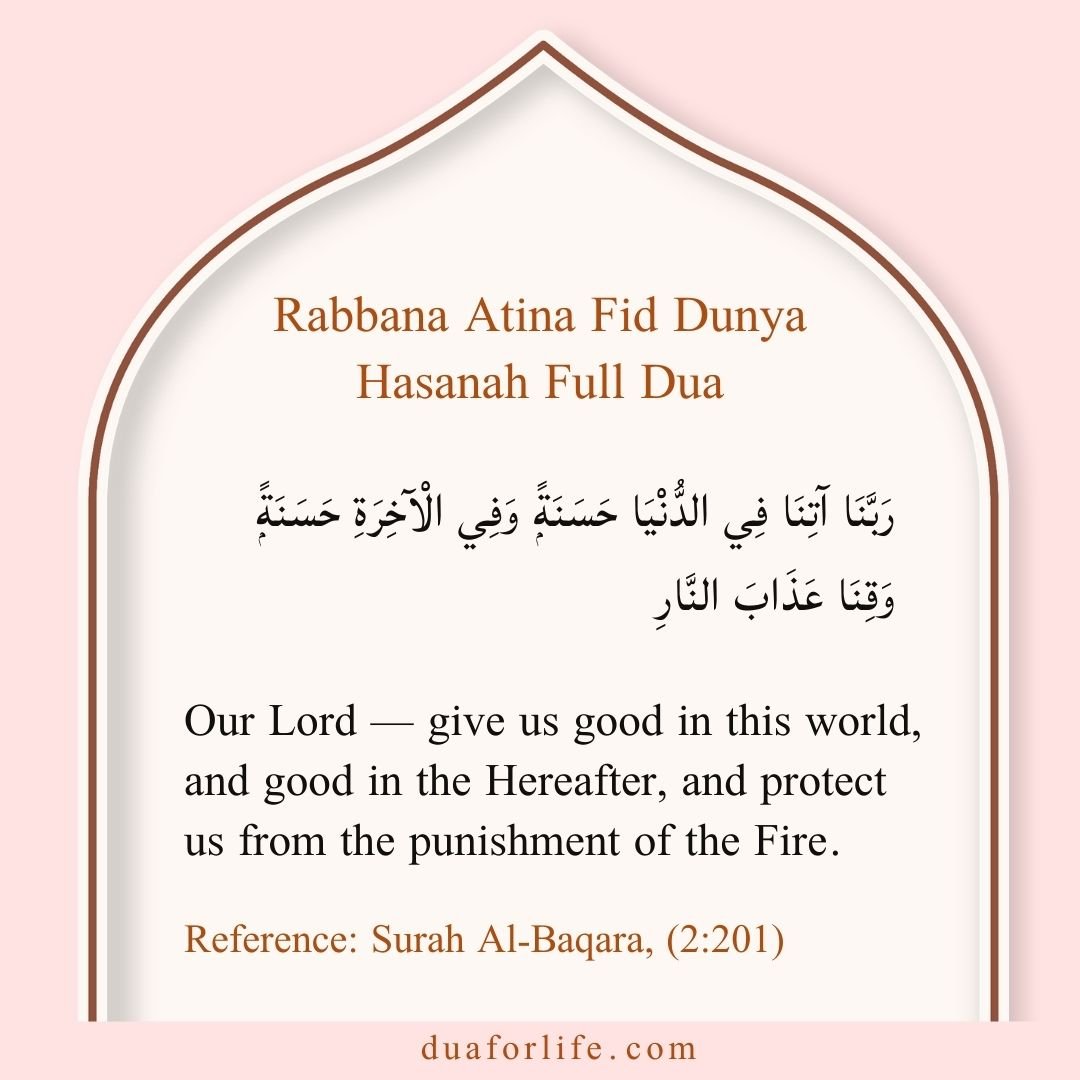
“Rabbana Atina Fid Dunya Hasanah” means: “Our Lord, give us good in this world and good in the Hereafter, and save us from the punishment of the Fire.” It’s a compact request for balanced blessing and safety.
2. Where is the dua “Rabbana Atina Fid Dunya Hasanah” found in the Qur’an?
It appears in Surah Al-Baqarah, Ayah 201 (Qur’an 2:201).
3. Is this dua from the Prophet ﷺ or only from the Qur’an?
Both: the wording is in the Qur’an (2:201) and the Prophet ﷺ frequently used this supplication — reported in Sahih al-Bukhari and Sahih Muslim.
4. When is the best time to recite it?
There’s no single “best” time — but common moments include sujood (prostration), after tashahhud, during tahajjud, and any sincere private dua time. Scholars note it’s permissible to use Qur’anic dua in sujood if intended as supplication.
5. Can I say this dua in sujood (prostration)?
Yes — scholars explain that although reciting Qur’anic verses in prostration as recitation is not recommended, using Qur’anic words as supplication with the intention of dua is allowed and practiced.
6. Do scholars recommend saying anything after this dua?
It’s common to follow the dua with specific requests (e.g., “O Allah, grant me halal rizq…”). The dua itself is comprehensive; specifics are optional and useful to focus your heart.
7. Is there a sunnah on how many times to say it?
No fixed number is required. The Prophet ﷺ used it often; recite it sincerely and regularly. Some people incorporate it into morning/evening dhikr routines.