If you’re anything like me, Tahajjud feels like that gentle, private doorway into Allah’s presence — quiet, a little fragile, and priceless. I’ve spent some nights trying to make sense of how to turn those sleepy, precious minutes into honest conversations with Allah. That’s why I wrote this post: a practical, authentic, human guide to a Dua for Tahajjud — not just text on a page, but the actual words, the context, and the how-to so you can start tonight (or improve what you already do).
Indact, I’ll show you several well-authenticated supplications the Prophet ﷺ used or recommended for the night (with Arabic + full ḥarakāt, transliteration, translation, and hadith/Qur’anic references). I’ll also explain when and how to recite them, the etiquette that helps dua feel real, and short, honest notes from my own experience. Read or skim — I made it scannable — but keep the heart open. Tahajjud rewards patience, sincerity, and small steps.
Recommended: Rabbana Zalamna Anfusana Dua in English, Arabic and Meaning
More Duas for Tahajjud Prayer: A List of Tahajjud Duas
When you stand in the quiet of the night, every word you say matters. These are some of the most authentic and powerful duas you can recite during Tahajjud — whether you’re seeking forgiveness, guidance, provision, or peace. Each comes from authentic sources — the Qur’an and the Sunnah — and carries deep meaning when recited with sincerity.
1.
Arabic:
اللَّهُمَّ إِنَّكَ عَفُوٌّ تُحِبُّ الْعَفْوَ فَاعْفُ عَنِّي
Transliteration:
Allahumma innaka afuwwun tuhibbul-afwa fa’fu anni
English Translation:
“O Allah — You are Most Pardoning; You love pardon — so pardon me.”
Reference: Jami` at-Tirmidhi 3513
2.
Arabic:
اللَّهُمَّ إِنِّي أَسْأَلُكَ عِلْمًا نَافِعًا وَرِزْقًا طَيِّبًا وَعَمَلًا مُتَقَبَّلًا
Transliteration:
Allahumma inni as’aluka ilman nafi‘an wa rizqan tayyiban wa ‘amalan mutaqabbalan
English Translation:
“O Allah, I ask You for beneficial knowledge, good (halal) provision, and deeds that are accepted.”
Reference: Sunan Ibn Majah 925
3.
Arabic:
رَبَّنَا آتِنَا فِي الدُّنْيَا حَسَنَةً وَفِي الآخِرَةِ حَسَنَةً وَقِنَا عَذَابَ النَّارِ
Transliteration:
Rabbana atina fid-dunya hasanatan wa fil-akhirati hasanatan wa qina ‘adhab an-nar
English Translation:
“Our Lord, grant us the good of this world and the good of the Hereafter, and protect us from the punishment of the Fire.”
Reference: Surah Al-Baqarah (2:201)
Recommended: Benefits of Reciting Sura Kahf Dua: Guidance and Mercy from Allah
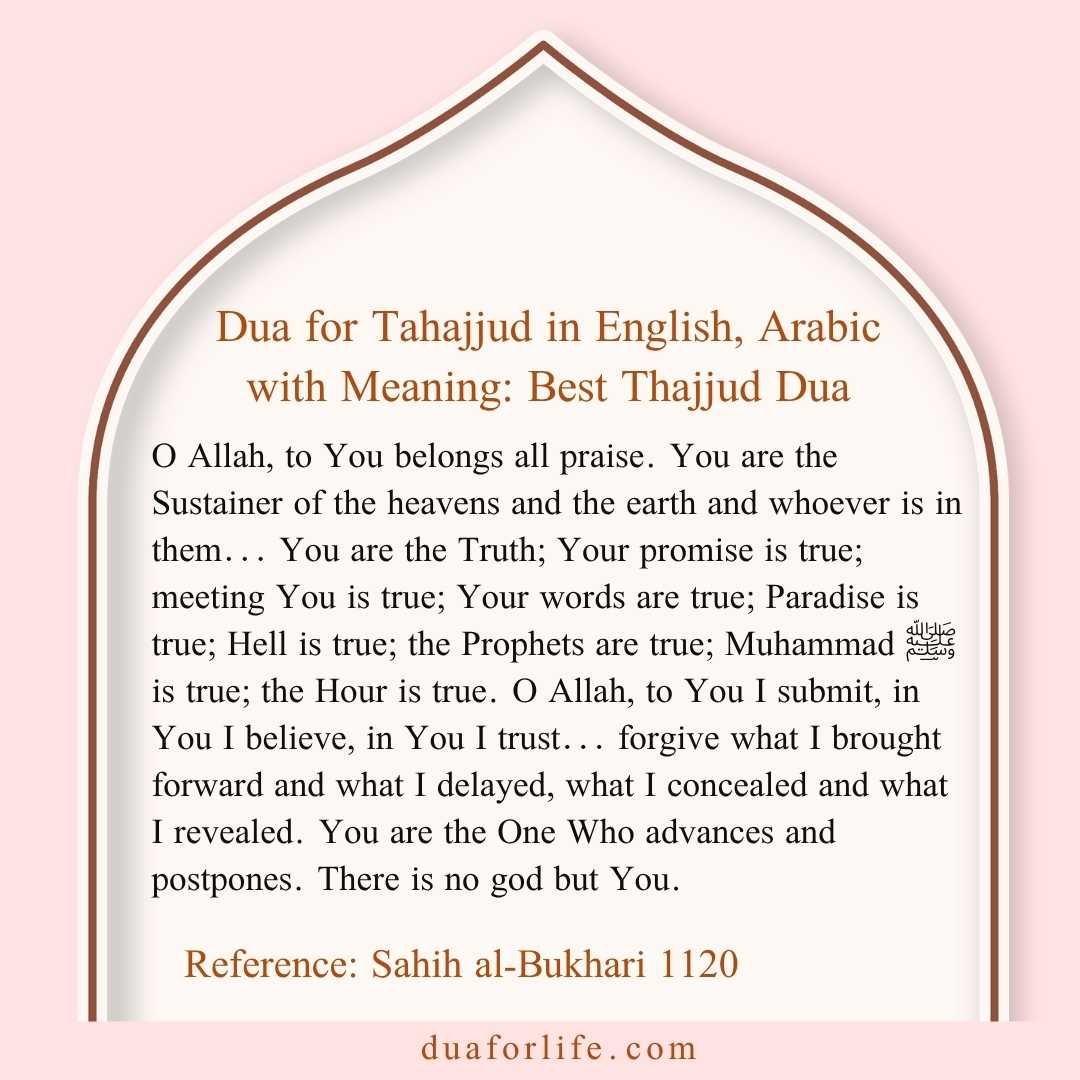
A brief overview of these duas (Dua for Tahajjud)
When people say “the Dua for Tahajjud” they often mean the set of authentic supplications the Prophet ﷺ taught to use at night — the praise/dhikr he said when rising, the concise duas for forgiveness or provision, and the Qur’anic dua for a balanced life. Tahajjud is less about one exact sentence and more about the spirit — praise of Allah, sending salutations on the Prophet ﷺ, asking for forgiveness, then making your personal requests. The Prophet ﷺ used a number of formulas and we can follow those authentically while also speaking to Allah from the heart. The night is a mercy-window: Allah descends to the lowest heaven in the last third and invites sincere supplicants.
Recommended: Benefits of Tahajjud Prayer: Timing, Dua & Life-Changing Rewards
Benefits of reciting these duas during Tahajjud Prayer
You’re asking at the best time. The last third of the night is highlighted in hadith as a moment when Allah answers. It’s the spiritual “open hours.” Sunnah
Direct Sunnah links. The Prophet ﷺ modeled these words — saying them connects you to the living tradition (which brings calm and clarity). Sunnah
Duas are practical and balanced. The Qur’anic example (Rabbana atina…) asks for the worldly and the eternal — it helps shape your priorities and ask for what truly matters. Quran.com
Inner transformation. Tahajjud and its duas shape discipline, vulnerability, and reliance on Allah — real benefits that show in everyday patience, decisions, and peace. (Experience + spiritual psychology.)
Recommended: Dua for Happiness and Success: Powerful List of Duas in English
When & How to Recite these Duas — step-by-step
I keep this part as actionable as possible — no fluff.
Time: Aim for the last third of the night — the optimal window. If you’re calculating: last-third = when remaining time till Fajr is about one-third of the night. The hadith describes Allah’s special descent at this time.
Wake gently, make wudu if you can. A small ablution resets the mind. If you can’t, a focused heart still counts.
Start with short dhikr & praise. Use the Prophet’s opening (the long “Allāhumma laka-l-ḥamd…”) or simpler praise like “Subḥānallah, Alḥamdulillah, Allāhu Akbar.” The pattern is: praise → salawāt → a moment of silence → ask.
Make sujood dua. The Prophet ﷺ taught that the servant is closest to his Lord in prostration — increase supplications there. That’s a beautiful, intimate place to pour out your heart.
Use the authenticated duas I listed. Start with a Sunnah formula (for example, “Allāhumma innī as’aluka…”), then move to your personal requests: family, guidance, provision, healing — be specific, honest, and ask for halal.
Be persistent and polite. Start with praise, send blessings on the Prophet ﷺ, ask, then conclude with “Ameen.” Don’t rush — silence and repetition show sincerity.
Finish with dhikr & dua for others. End by asking for forgiveness and for the Ummah. Charity of the tongue.
Consistency beats marathon nights. I’d rather wake for two sincere minutes most nights than perform a showy long session once in a month. The Prophet praised steady practice.
Quick etiquette checklist: humility, specific requests, asking for halal, repeating (three, seven times if it helps your focus), tear or emotion when present — all fine. Avoid showy recitation or performance. The inner state matters most.
Recommended: Rabbana Atina Min Ladunka Rahma Full Dua from Surah Al-Kahf
Personal Reflection on Tahajjud Dua
I’ll keep this short: I don’t always wake up for Tahajjud, and honestly, I’m still trying to build that habit. But even when I just think about it — those quiet hours before dawn, when the world feels still — something stirs in me. It reminds me that turning to Allah doesn’t have to be grand or perfect. Sometimes, a single sincere thought like “O Allah, guide me through this” carries more weight than a long, rehearsed dua said at the wrong time. Reading about Tahajjud and its duas has taught me that what matters most is sincerity, not routine. Even a small, genuine moment of connection — whether it’s reflection, gratitude, or just whispering Allah’s name — can bring peace that lingers through the day.
Final thoughts
If you’re just starting, don’t aim for a flawless ritual. Start with one rakʿah, one dua, and build. Use the prophetic formulas to anchor your speech, but always finish with your real words to Allah. Tahajjud isn’t a checklist — it’s a relationship. Make dua like you would with someone you trust. And when you doubt whether it “worked,” remember: acceptance sometimes looks like patient endurance, sometimes like immediate relief. Both are mercy.
Recommended: Dua for Rizq and Success: Duas for Increasing Rizq and Success
For more dua like this, check out this page. You can also check out All Dua page.