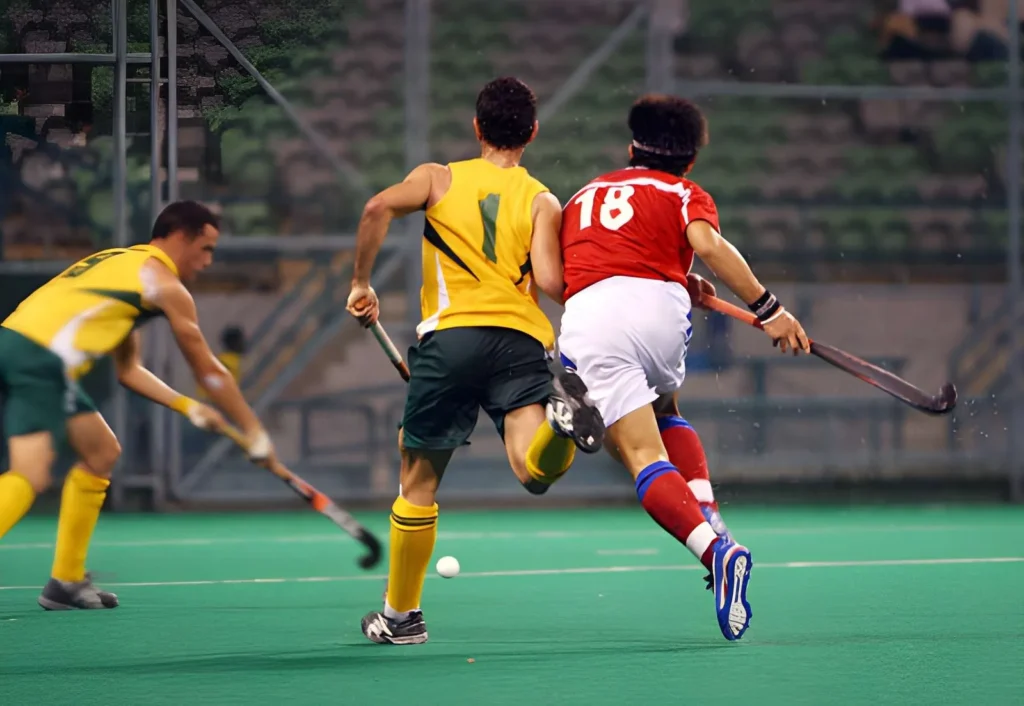
A goalkeeper in field hockey can spend long periods outside the center of play and then face a shot that decides a match within seconds. PR Sreejesh built his career around handling these transitions. His importance to India came not only from spectacular saves but from positioning, anticipation, communication, penalty-corner defense, and the ability to make decisions when there was little time for correction. He became a central figure in a period when India returned to the Olympic podium and rebuilt its status in international hockey.
Goalkeeping is also a position where outcomes can appear binary: save or goal. Yet the process behind each outcome is much more complex than a simple fifty-fifty event. While a coin flip casino game is based on chance, Sreejesh’s work in goal depended on preparation, reading body movement, controlling angles, and recognizing patterns. The best save often began before the striker released the ball.
Positioning Reduced the Size of the Target
One of the foundations of Sreejesh’s goalkeeping was his ability to position himself according to the location of the ball.
A goalkeeper does not need to cover the entire goal equally at every moment. The shooting angle changes as the attacker moves. By stepping forward or shifting across the line, the goalkeeper can reduce the visible target.
This creates a constant calculation. Moving too far forward may leave space behind or make a lateral pass dangerous. Staying too deep gives the attacker more of the goal to aim at.
Sreejesh’s experience helped him manage this distance. His positioning meant that some saves that looked like reactions were partly created by decisions made before the shot.
Reading the Attacker Before the Shot
Reaction speed matters, but international shots can travel too quickly for pure reaction to solve every situation. Goalkeepers therefore search for information before contact.
The attacker’s body angle, stick position, approach speed, and direction of movement provide clues. Sreejesh could use these signals to prepare for likely outcomes without committing so early that the attacker could exploit his movement.
This was important in one-on-one situations. The striker might shoot, attempt a dribble, or pass across goal. If the goalkeeper commits to one option too soon, another becomes available.
Sreejesh often tried to remain balanced until the attacker revealed enough information. That patience allowed him to react from a stronger position.
Penalty Corners Required More Than Reflexes
Penalty corners place the goalkeeper at the center of a planned attacking sequence. The defense knows where the ball will enter the circle, but it does not know which routine will follow.
The attacking team may use a drag flick, direct hit, deflection, pass, or variation designed to move defenders out of position.
For Sreejesh, defending these situations required preparation before the match. Opponents could be studied for preferred flick directions, common routines, and tendencies under pressure.
During the corner itself, he also needed to coordinate with the runners and defenders on the goal line. Their movement affected which parts of the goal he needed to prioritize.
Penalty-corner defense was therefore a team system with the goalkeeper at its center.
Communication Was Part of His Defensive Role
A goalkeeper sees the field from a different perspective than an outfield player. From behind the defense, Sreejesh could observe attackers moving into spaces that defenders might not see.
Communication allowed him to influence situations before they became shots.
He could alert teammates to unmarked players, direct defensive positioning, and help organize the structure when India was under sustained pressure.
This aspect of goalkeeping is difficult to capture through save statistics. A goalkeeper who helps prevent a shot from occurring receives no recorded save, but the intervention still has defensive value.
Experience made this communication more efficient. Sreejesh could identify which information mattered and deliver it while the game continued.
Shootouts Tested Decision-Making
Shootouts create a different problem from normal goalkeeping. The attacker has space to approach, change direction, and attempt to manipulate the goalkeeper before shooting.
The goalkeeper must decide when to move forward and when to hold position.
Sreejesh’s approach depended on controlling the attacker’s options. Moving out can reduce shooting angles, but excessive commitment allows the attacker to move around the goalkeeper.
Patience becomes as important as speed.
The psychological pressure is also different because each attempt is isolated and the consequences are visible immediately. Experience helps a goalkeeper maintain the same decision process regardless of what happened on the previous attempt.
Big Saves Changed More Than the Score
A save has an obvious numerical value because it prevents a goal. In some situations, however, it also changes how a match develops.
When a goalkeeper stops a major chance, defenders can gain confidence in maintaining their structure. Opponents may become more selective or attempt different finishing options.
Sreejesh’s ability to produce saves during periods of pressure therefore had tactical consequences. India could survive sequences in which opponents controlled possession and then attempt to rebuild from the next phase.
This became particularly important in tournament hockey, where one goal can separate teams and where knockout matches provide little room for recovery.
Longevity Added Tactical Knowledge
Sreejesh’s long international career gave him another resource: accumulated information.
He faced different generations of attackers, changes in tactical systems, and variations in penalty-corner methods. Repeated exposure allowed him to recognize patterns faster.
Longevity also meant adapting physically and tactically. A goalkeeper cannot rely on the same qualities throughout an entire career. Positioning and anticipation can become more important as experience grows.
Sreejesh showed how technical knowledge could complement physical reactions rather than replace them.
Why Sreejesh Became So Important to India
PR Sreejesh’s importance cannot be explained by one tournament or one collection of saves. His role combined several functions that modern hockey demands from a goalkeeper.
He protected the goal through positioning and reaction. He studied penalty-corner patterns. He managed one-on-one situations through patience. He communicated with defenders and contributed to the organization of the team. In pressure situations, his experience helped turn preparation into decisions.
His career also overlapped with a major period in Indian hockey, including Olympic bronze medals in Tokyo and Paris. Those team achievements gave his contribution a wider historical context.
The defining feature of Sreejesh’s goalkeeping was therefore not simply his ability to stop shots. It was his capacity to influence what happened before, during, and after them. That combination of technical execution, tactical reading, communication, and experience made him one of the most important goalkeepers of India’s modern hockey era.


