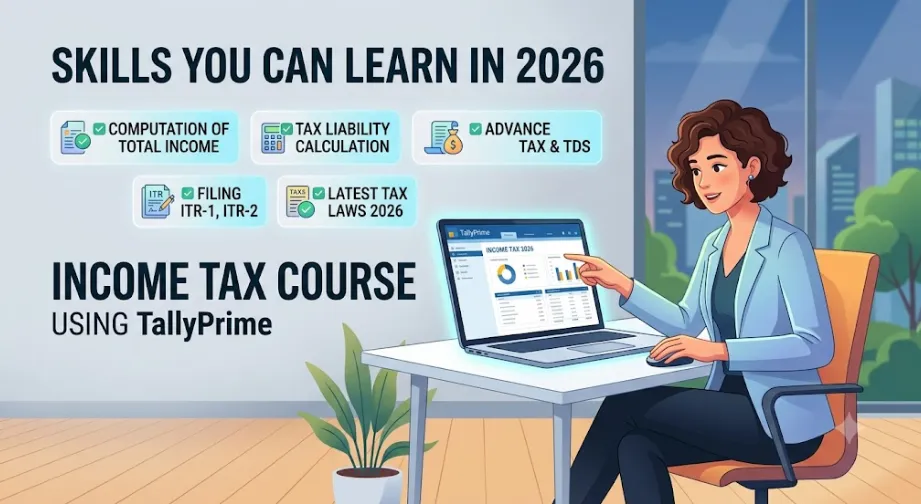
Understanding taxation is an important skill for students, accounting professionals, business owners, and anyone looking to build a career in finance. An Income Tax Course that includes practical training with TallyPrime can help learners understand tax concepts while developing the technical skills needed to manage accounting and taxation tasks efficiently.
TallyPrime is widely used for accounting and business management activities. Learning how taxation-related processes work alongside accounting software can give students practical exposure and help them prepare for accounting, taxation, payroll, and finance-related roles.
But what exactly do you learn in an Income Tax Course using TallyPrime? Let’s explore the key topics typically covered.
1. Introduction to Income Tax
An Income Tax Course generally begins with the fundamentals of income tax. Students learn about the purpose of income tax, different types of taxpayers, financial years, assessment years, and basic taxation terminology.
The course may also introduce learners to taxable income and the broad categories under which income is calculated. Understanding these fundamentals creates a strong foundation for more advanced taxation concepts.
2. Understanding Different Sources of Income
Income can come from different sources, and each category has specific taxation rules. A practical Income Tax Course introduces learners to the major heads of income, such as:
- Income from salary
- Income from house property
- Profits and gains from business or profession
- Capital gains
- Income from other sources
Learning how income is categorized helps students understand how taxable income is determined and how different transactions may affect tax calculations.
3. Taxable Income and Deductions
Another important topic is the calculation of taxable income. Learners are introduced to deductions and exemptions that may be applicable under the Income Tax Act.
Students can understand how gross income is adjusted using eligible deductions to arrive at taxable income. Practical examples can make these concepts easier to understand and apply in accounting scenarios.
4. Income Tax Calculations Using TallyPrime
One of the major advantages of combining taxation concepts with accounting software is practical learning. Students can understand how accounting data can support tax-related calculations and reporting.
A course using TallyPrime may provide practical exposure to:
- Recording accounting transactions
- Maintaining ledgers
- Managing income and expenses
- Reviewing financial information
- Generating relevant reports
- Using accounting data for taxation-related activities
This hands-on approach can help learners connect theoretical taxation concepts with everyday accounting operations.
5. Payroll and Income Tax Concepts
For learners interested in both accounting and human resource functions, a Payroll and Income Tax Course can provide broader career-oriented knowledge.
Payroll involves managing employee salaries, deductions, attendance-related information, and statutory requirements. Students can learn how salary-related information connects with income tax calculations and payroll processing.
Topics may include:
- Salary structure
- Employee deductions
- Taxable salary
- Payroll processing
- Tax deductions from salary
- Employee tax-related records
This combination can be particularly useful for learners planning careers in payroll administration, accounting, or finance operations.
6. Tax Deducted at Source (TDS)
TDS is another important area covered in taxation-focused training. Students can learn the basic principles of tax deduction at source, applicable transactions, and the importance of maintaining accurate records.
Practical training can help learners understand how TDS-related information is recorded and reviewed as part of accounting and compliance processes.
7. Tax Reports and Financial Records
Maintaining accurate financial records is essential when working with taxation. An Income Tax Course can teach students how to organize accounting information and use reports to support tax-related activities.
With TallyPrime-based practical training, learners can become familiar with financial reports, ledgers, vouchers, and other accounting information that can assist in reviewing business transactions.
8. Practical Accounting and Taxation Scenarios
A strong course should go beyond theoretical concepts. Practical exercises can help students work with examples based on common business transactions.
Learners may practice recording purchases, sales, expenses, income, and other transactions before analyzing the resulting accounting information. This approach helps develop confidence in using accounting software and interpreting financial data.
9. Payroll Management Training
Learners who want to expand their skills can consider Payroll Management Training alongside taxation and accounting education.
Payroll training can introduce important areas such as salary processing, employee records, payroll calculations, deductions, and payroll reports. Combining payroll knowledge with income tax and accounting skills can make a learner more versatile for finance and HR-related roles.
10. Career-Oriented Accounting and Tax Skills
The final objective of an Income Tax Course using TallyPrime is to develop practical, job-relevant skills. Instead of learning taxation in isolation, students can understand how accounting, payroll, and taxation processes are connected in an organization.
This knowledge can be useful for roles such as:
- Accounts Executive
- Tax Assistant
- Payroll Executive
- Junior Accountant
- Accounts Assistant
- Finance Executive
- Taxation Assistant
Why Choose an Income Tax Course with Practical TallyPrime Training?
Learning income tax alongside accounting software can provide a more practical understanding of how financial information is managed in organizations. TallyPrime training can help learners work with accounting transactions and reports, while taxation modules introduce the concepts needed to understand tax-related requirements.
For students looking for broader career preparation, a Payroll and Income Tax Course can provide an additional advantage by combining taxation knowledge with payroll management skills.
Conclusion
An Income Tax Course using TallyPrime can cover much more than basic tax theory. From understanding sources of income and taxable income to learning accounting processes, TDS, payroll concepts, and financial reports, students can develop a broader understanding of accounting and taxation.
Adding Payroll Management Training can further strengthen these skills and prepare learners for a variety of accounting, payroll, finance, and taxation-related opportunities. For anyone looking to build practical accounting skills, choosing a course that combines taxation concepts with hands-on software training can be a valuable step toward career development.


